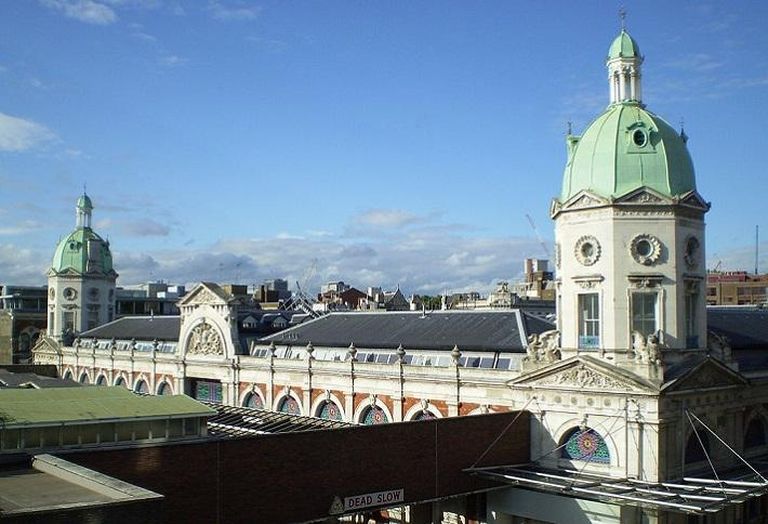
An ancient Royal Charter is the latest stumbling block in the City of London’s plans to rejuvenate one of its central meat markets.
Successive government ministers have thrown out regeneration plans. Now plans to regenerate Smithfield market into a £330M museum have been held up again, this time by an ancient royal law.
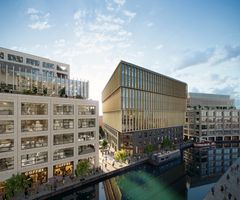
The City, which acts as the local authority over the historic 'Square Mile' has long held plans to redevelop the site close to Farringdon station and the new Crossrail route.
However, traders at the historic central London market have claimed that a centuries-old Royal Charter, established to allow a market to be located at the site, gives them special rights to stay in their current location and fend off attempts to move the market to a site up to 14 miles away in east London.
Traders have stated that their protected status at the historic market is licensed by a Royal Charter and would need an Act of Parliament to remove them.
A City of London Corporation spokesperson told Bisnow that it aims to get the law changed later this year.
A spokesperson said: "The City of London Corporation remains committed to co-locating London’s three historic wholesale markets — Billingsgate, Smithfield and New Spitalfields — at Dagenham Dock and to working with the tenants of all three markets to achieve this.
“We intend to deposit a private bill to the Houses of Parliament later this year for approval to move the markets."
Smithfield has a long history as a key part of London’s commercial food chain. The area was used as a Roman burial site and later as a place for public executions and medieval jousting tournaments.
A charter granting the use of the land for a weekly market was issued in the 14th century as part of plans to ensure the slaughtering of animals was undertaken outside of the old City walls. According to the City of London the local authority formalised the collection of tolls at the market in 1638. The new museum would be based at the General Market buildings, which were designed in the 1860s by Sir Horace Jones.
Part of the Victorian market burnt down in 1958 and was replaced by a modern structure in the 1960s. Despite most of the site staying in use as a meat market, the General Market on the corner of Farringdon Road and Charterhouse Street closed in the 1990s and has since deteriorated.
Since then several attempts to regenerate the derelict market have been thrown out by successive governments. Plans brought forward in 2008 were rejected by the former Labour government's communities secretary Hazel Blears.
Redesigned plans brought forward by developer Henderson Global Investors (now Nuveen) were rejected in 2014, this time by Conservative minister Eric Pickles, despite strong support from the City of London itself.
If the new law is approved then the City of London hopes the new museum, which will be renamed The London Museum, will be open by 2026.