
Corporate office occupiers didn’t know it at the time, but the pandemic gave them a head start on the artificial intelligence revolution.
AI’s integration into daily workflows is pushing more occupiers into smaller, higher-quality space with a focus on collaborative environments, the same trends that have defined postpandemic office demand. The dynamic is accelerating the bifurcation of the office market as occupiers adopt a leaner operating model and adapt to a more discerning workforce.
“Corporate real estate portfolios need to be agile, fluid and liquid, because the changes are continuing,” said Peter Miscovich, who leads JLL’s global future of work business line from New York. “In the good old days, signing a 20-year lease meant being pretty set on that envelope commitment. That has certainly changed.”
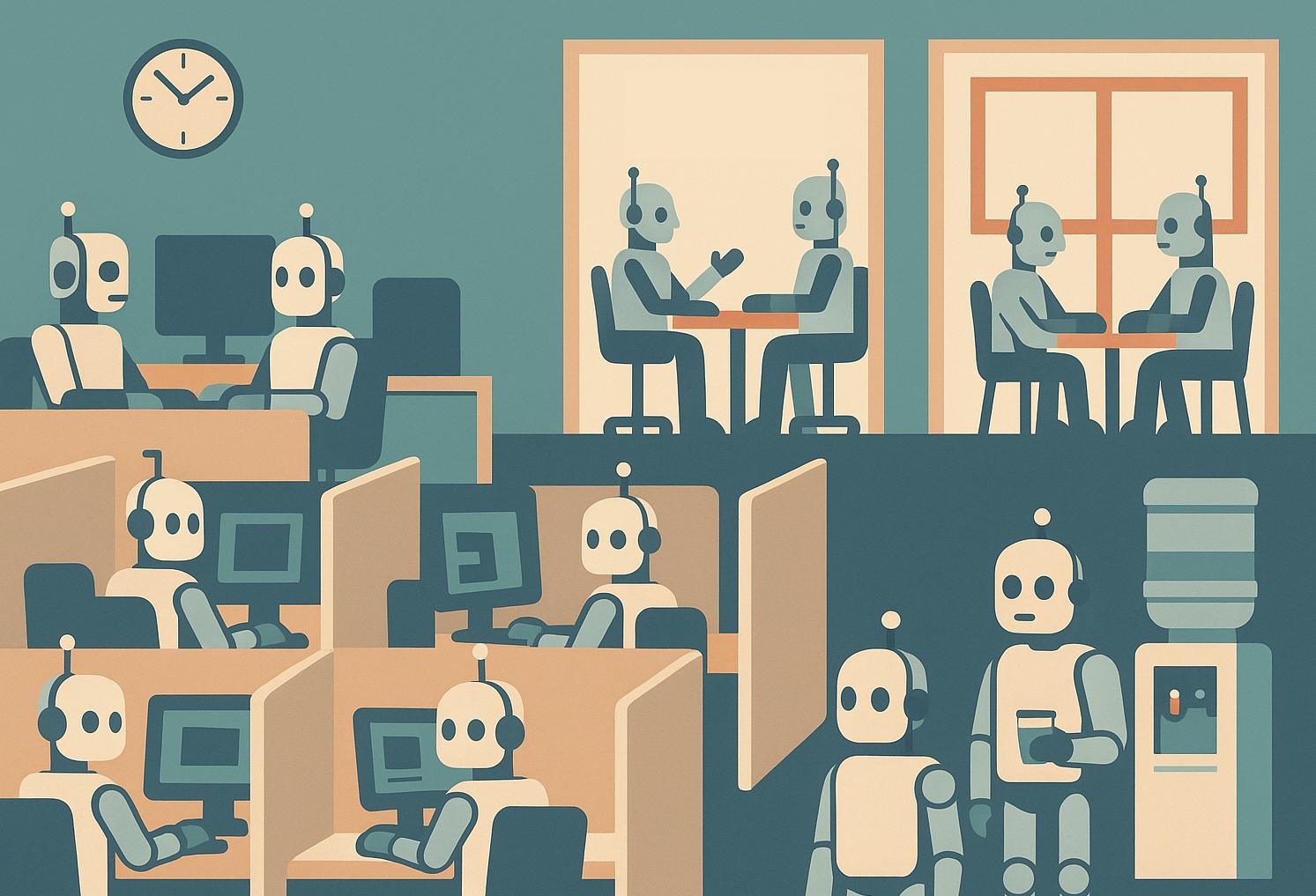
The long-term, fixed leases that have underpinned the office sector for decades are an increasingly risky deal for tenants as they navigate the stickiness of hybrid work models, macroeconomic uncertainty clouding real estate valuations and the impact of AI on space requirements, Miscovich said.
Space planning has gone from a once-a-decade ordeal for occupiers to something that some users now grapple with every quarter.
“We are counseling companies to take a scenario approach, and we're refreshing that approach, in some cases, every three months or every six months,” he said. “That is the new normal in terms of evergreen strategic planning.”
There’s anything but agreement about the impact of AI on the global workforce, and existing corporate deployments of the technology with transformative results remain scant. The World Economic Forum predicts AI will eliminate 9 million jobs across the globe by 2030, but those losses will be offset and overcome by 11 million new jobs that the tech is projected to create.
But Dario Amodei, the CEO of artificial intelligence giant Anthropic, thinks up to half of entry-level jobs could be made obsolete by the tech his company is developing. Sam Altman, the visionary head of ChatGPT parent company OpenAI, said that millions of jobs are at risk and that “we are past the event horizon; the takeoff has started” in a June blog post.
But there are doubters. Among them is Goldman Sachs Head of Global Equity Research Jim Covello, who rattled investors with a report last June questioning why trillions of dollars were being poured into an as-yet unproven technology. Even the billionaire chairman of Chinese conglomerate Alibaba Group has warned that an AI bubble could be forming in the U.S.
“I have a friend who calls them the AI arms merchants,” Miscovich said of the tech executives trying to sell their products for enterprise solutions. “They're very self-interested in some of their forecasts.”
McKinsey Global Institute predicts that the largest job losses from tech advances will be seen in office support, customer service and food service roles. It estimates that 710,000 administrative assistants could be made obsolete by new tech, including AI, by 2030.
Demand for office support jobs will slip by 18% by 2030, although it will be offset by an 11% growth rate for management roles, according to McKinsey forecasts.
That workforce has already been squeezed into a smaller footprint as companies push for space efficiency. The average global office space offered 132 SF per person in 2025, down 20% from the prior year, according to the JLL Global Occupancy Planning Benchmark Report.
“There'll be greater job creation than job displacement, but the mix of jobs will change from the more processing and administrative functions to more [science, technology, engineering and math]-based or creative functions,” Lenny Beaudoin, CBRE Executive Managing Director and Global Lead of Workplace, Design and Occupancy, said.
“The environment that supports one or the other has been different historically and should be different in the future. And so that's going to challenge legacy space that was set up for more back-of-house — operations, production, processing and clearing-type functions,” he said.
If the roughly 700,000 administrative assistants that McKinsey expects will need to find new work by 2030 are cut from the workforce, it would amount to 92.4M SF of excess office space. But AI’s boosters expect that it will ultimately create more jobs than it eliminates, and training initiatives are expected to help smooth the transition of workers from jobs with shrinking demand.
By McKinsey’s count, 92 million existing jobs across the globe face displacement by tech — including AI — by 2030, but another 170 million jobs will be created. WEF, which also predicts a net increase in jobs, estimates that just 11% of workers will be unable to get the necessary training to stay in their roles.
“The human component here, as human beings, we need a bit of time for adaptation,” Miscovich said. “That's why, at JLL, we're focused on upskilling and workforce training in terms of AI adoption, and our client organizations are certainly focused on that.”
The integration of AI into corporate workflows is still in the early stages, but it is happening faster than the string of transformational waves that have washed over the sector in the last few decades, from high-speed internet to the hybridization of work, Beaudoin said.
AI’s adoption promises to provide new fuel to pandemic-era trends as companies attract top talent by flocking to high-quality office spaces that have been designed from scratch to prioritize collaboration and feel inviting. Productivity is expected to soar as so-called agentic AI tools are baked into corporate workflows, which AI’s proponents say will fundamentally shift how companies scale.
Venture capital investors today see AI as decoupling headcount from revenue growth, Miscovich said. Investors have told him that “the AI company of tomorrow may be no more than 50 people at $100M or $200M of revenue as part of their business model,” he said. “If we think about how that applies to corporate enterprise organizations, we are seeing that organizations are trying to do more with less people.”

In the short run, that translates to businesses leasing less space, but a larger shift in corporate leasing strategy is happening under the surface. Ten-year leases are an increasingly risky bet for corporations, Miscovich said. Instead, there’s a shift towards shorter-term deals with multiple extension options and the integration of coworking space into portfolios to enhance scalability.
Instead of recruiting talent and bringing them into a corporate headquarters, large firms are increasingly looking at nodes in tech-centric markets like San Francisco, New York, Seattle and Boston where teams can coalesce.
Amazon is one high-profile example. The tech giant paused construction on the second phase of its Virginia headquarters in early 2023, but it continues to close deals for smaller spaces in key markets.
It signed a 330K SF lease in New York in April and a 76K SF deal in Miami’s trendy Wynwood neighborhood in June, more than a year after founder Jeff Bezos relocated to Miami and the company began searching for space in the area.
The tech giant is also leaning on coworking provider WeWork to scale its presence in core markets, including with a 141K SF deal in Silicon Valley and others in New York, Dallas and Nashville.
Amazon is also refocusing its efforts to get employees into not just offices, but the right offices. The firm’s initial return-to-work policy allowed employees to show up at any of its global offices five days a week, but Amazon management told several thousand staff in June that they could either resign or relocate to other cities to work in person with their teams.
The order came a few days after Amazon CEO Andy Jassy wrote a memo to staff that explained why he expected AI to shrink the company’s headcount.
But while major tech firms continue to hold on to some of the ethos characteristic in Facebook’s now-retired “move fast and break things” motto, commercial real estate as a sector isn’t known for its quick reaction speed.
“Everything we just discussed was really focused around technology and strategic planning, and, fortunately or unfortunately, corporate real estate is a bit of a laggard to those leading indicators,” Miscovich said.
)
)
)
)
)
)
)
)
)
)
)
)