
Build-to-rent is no longer an early-stage product.
Six years ago, the industry was still hashing out the finer details on what to call itself. Dan Goldberg, president of the student housing and BTR operator and developer Core Spaces, said major players in the space got together through the Urban Land Institute’s Single-Family Rental Council to define common vernacular and industry expectations.
“When we market to search engine optimizations on Google, no consumer in our experience is Googling, ‘How can I get build-to-rent product?’” Goldberg said.
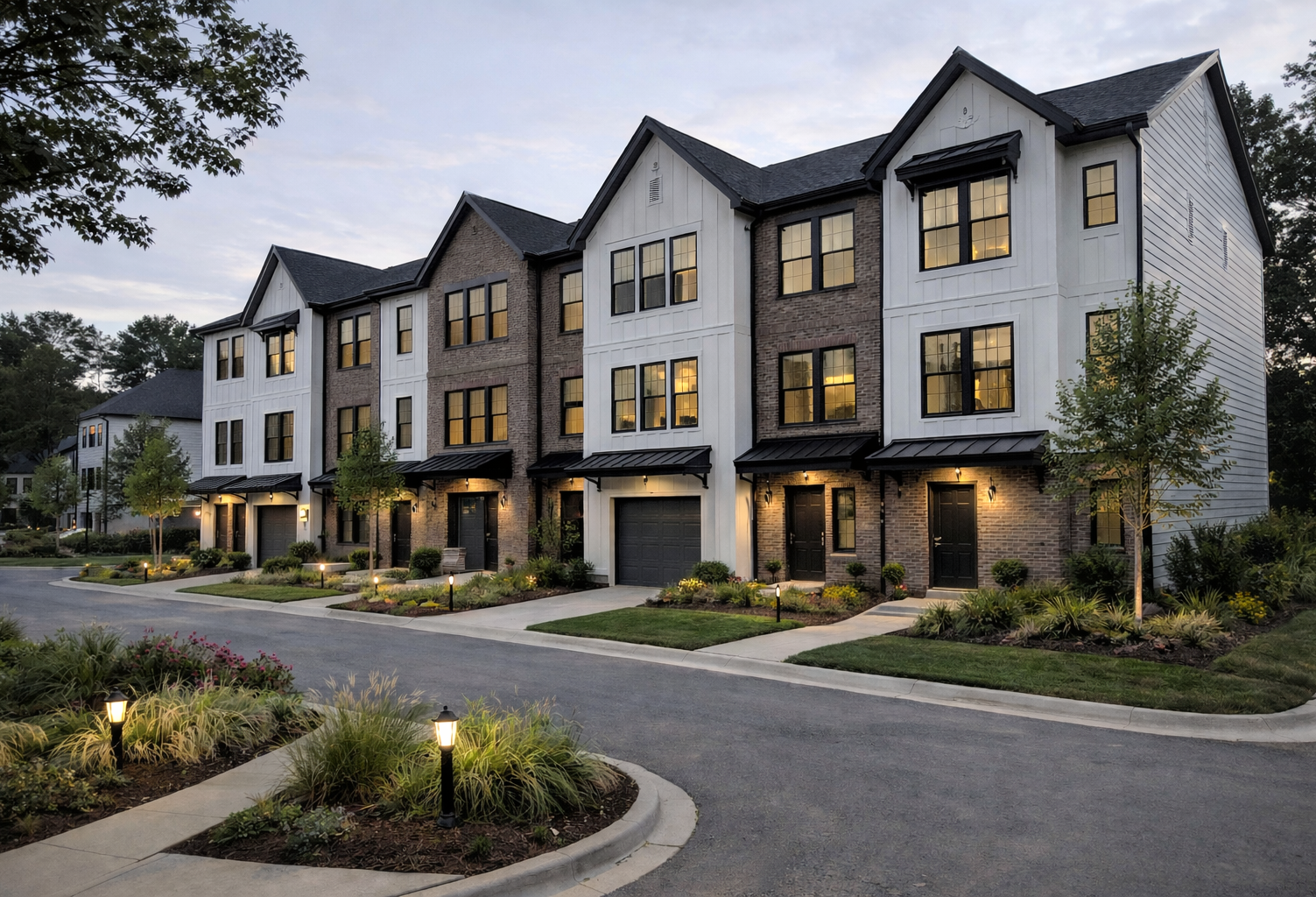
BTR falls under the single-family rental umbrella and is typically made up of communities of 50 or more homes or townhomes. It usually has a lower density than traditional multifamily.
In the early 2020s, BTR made up around 4% of single-family construction starts, according to Arbor Realty Trust. It peaked at about 9% in 2023 and sat around 7% at the midpoint of 2025.
BTR has turned into a multifamily engine with juice. Developers built 71,000 units in the asset class nationally in the 12 months ending in June, the most recent period for which data was available. Owners and operators are targeting an emerging demographic of renters and angling to take a bite out of the national housing affordability crisis as they navigate pushback in certain municipalities and from the president.
As of September 2025, a vast majority of BTR units under construction were in the South, with about 38,000 units underway, according to RealPage. That is more than the other three regions combined, with about 17,000 units in the West, around 6,000 units in the Midwest and roughly 2,000 in the Northeast.
Goldberg’s BTR pitch for prospective investors, wary neighbors and curious tenants is simple.
“What if we told you that we can create a community that feels like the community of single-family homes that you grew up in, but you didn't have to make the largest financial investment of your life?” Goldberg said.
On average, a mortgage was more expensive than renting a home in all of the largest 50 U.S. metros in 2025, according to Bankrate. The average 30-year fixed mortgage rate today is 6.01%, more than double the 2.65% rate at the beginning of 2021.
As of November, the share of first-time homebuyers fell to a record-low 21%, while the median age of first-time buyers rose to 40 years, a record high, according to the National Association of Realtors.
BTR communities are playing an increasingly important role in helping solve the housing affordability issue across the country, said Julie Workman, real estate attorney and partner at Chicago-based law firm Saul Ewing.
“Build-to-rent communities are sort of a way around the affordability crisis,” she said. “[People] want the structure of a single-family home. But because of mortgage rates, interest rates, the pricing just doesn't work for a lot of people.”
But while BTR players see their product as a viable alternative for people who can’t afford a home, President Donald Trump is assigning some of the blame for the widespread housing affordability crisis to single-family rental operators.
The president said Wednesday in a social media post that he would immediately begin taking steps to ban large institutional investors from buying more single-family homes. He said the American dream of buying and owning a home is increasingly out of reach for many people.
It is unclear how the administration views BTR communities in the broader single-family rental context, what restrictions would be in place or how Trump would attempt to implement a policy that he said he will call on Congress to codify.
The biggest question for @pulte: How would an institutional ban treat build-to-rent and impact housing supply?
— Lance Lambert (@NewsLambert) January 7, 2026
95.7% of institutional landlord AMH’s single-family acquisitions through the first three quarters of 2025 came via its in-house homebuilding unit pic.twitter.com/hogm4xUNYj
BTR is a category of housing that encompasses many different living styles, said Kevin Kwiatkowski, executive vice president at Redwood Living, which has about 22,000 BTR units in its portfolio.
“If the person who's renting the property has a door in and out of the elements, you could generally classify that as BTR,” Kwiatkowski said. “If you're in an apartment neighborhood and you're walking up a common hallway … that's generally multifamily.”
There are different types of BTR communities and product types. Those include detached single-family homes, ranch houses and townhomes.
Workman said the variety of product types in BTR helps to cater to different segments of potential residents.
“There are people who need small apartments, there are people who want luxury homes, and there are people who want everything in between, who need everything in between,” Workman said.
Redwood specializes in single-story row homes, while Core Spaces mixes ranch homes with two- and three-story detached homes in the same community.
Goldberg said Core Spaces’ strategy alleviates some leasing risk by offering unique product types to renters seeking different sizes of homes, but it makes it more complicated to build. The company can execute because of its experience and investment as a student housing developer.
“I like to say that our approach, for better or worse, is the anti-Truman Show approach, where we have lots of different types of homes,” Goldberg said.
When evaluating sites for potential BTR communities, Kwiatkowski said the company is looking for two criteria: population density within a 10-mile radius of the site and a minimum household income threshold of $75K. Most of the residents in its portfolio who move to its communities come from within that distance, and the threshold ensures they can afford rent.
The renter profile for BTR communities differs from that of traditional multifamily and ranges from aging millennials to downsizing boomers.

Redwood’s average tenant age is 51.5 years old, Kwiatkowski said. About 70% of its residents are in the empty nester category, with the other 30% composed of about 25% young professionals and 5% divorced people.
“People are renters longer,” Kwiatkowski said.
Goldberg said there is a ton of “uncapped demand” because BTR still isn’t really an institutional product type due to its newness. The long-term fundamentals are strong, with growth in its key target renter population and greater societal acceptance of renting versus owning.
From the investment side, Goldberg said he sees demand for BTR projects coming from a range of sources, including traditional multifamily investors, 1031 exchange buyers and family offices. Scattered-site operators, who operate individual single-family rental homes, are increasingly interested in BTR as a way to gain exposure to another type of single-family rental.
But BTR still faces some broader multifamily challenges nationwide.
National rent growth in the single-family rental market has decelerated for 11 consecutive months, bringing its pace to roughly 1 percentage point below the pre-pandemic norm, according to Arbor. Rents were still up 3.3% year-over-year through October.
Rising interest rates, inflation and a glut of supply in certain multifamily markets have contributed to a tough climate.
“In the short term, over the last couple of years, BTR performance has not been very strong nationally,” Goldberg said.
Issues of oversupply are generally more localized, Kwiatkowski said, even in those areas where supply will likely burn off, as buying and maintaining a house is a lot more expensive today than it has been in most people's lifetimes.
Goldberg said the ability to sell BTR communities depends on how each project is platted, or legally subdivided.
Single-plat communities function more like traditional multifamily assets and generally can’t be sold off home by home without a costly and uncertain replanning process, he said. Other communities are structured to allow individual home sales, though that is typically viewed as downside protection rather than a base-case exit strategy.
Platting also affects operations and financing, Goldberg said. Single-plat communities usually require the owner to build and maintain streets and utilities, but they tend to attract more traditional multifamily lenders and institutional capital because they resemble apartment complexes. Individually platted communities benefit from city-maintained infrastructure but come with different financing considerations and a narrower buyer universe, he said.
For Redwood, the proposition is simpler: The company has never sold a property it has built in its 34-year history, as its strategy is long-term holds of its assets, Kwiatkowski said. Instead, it builds properties with a construction loan, and once they are built and occupied, the company secures a permanent loan.
“There are a lot of investors, especially from the Wall Street private equity firms, that wish to buy Redwood,” he said. “We're not for sale. Our individual properties aren’t for sale.”
With an uncertain macroeconomic climate for multifamily investment and political pressure from the Trump administration on single-family rentals, the outlook for BTR is murky. But that won’t stop its operators from betting on the sector’s growth.
“We think that the supply glut and some of the interest thawing is going to happen over the next 12 to 18 months,” Goldberg said. “We're not trying to wait for the all-clear sign.”
)
)
)
)
)
)
)
)
)
)
)
)