
Tens of millions of square feet of warehouses built as recently as the first decade of the 21st century are no longer up to snuff.
Occupiers are increasingly dependent on robotics and automation, a trend that has made higher ceilings heights a top priority — and put older buildings at a disadvantage. To keep their properties competitive, some owners are employing a creative solution: physically raising the roofs.
“The biggest driver here is the racking,” CoStar National Director of U.S. Industrial Analytics Juan Arias said. “You can go much, much higher in racking now by implementing robotics.”
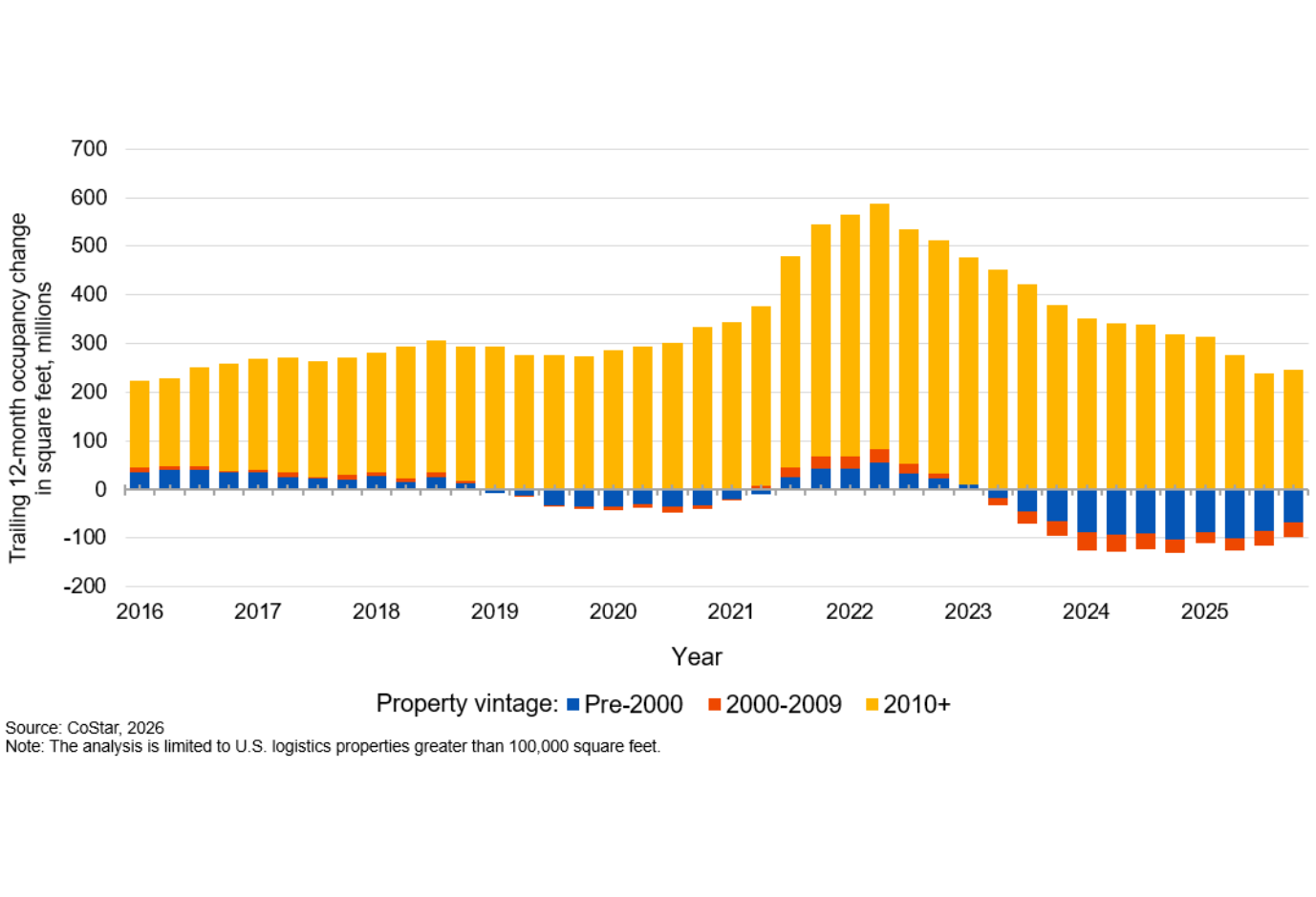
As logistics giants like Amazon pursue the greater efficiency permitted by higher racking, data from CoStar shows older industrial buildings — which tend to have lower ceiling heights — are falling out of favor.
Warehouses of 100K SF or larger built before 2010 suffered 96M SF of occupancy losses in 2023 alone, according to CoStar, as a wave of new pandemic-era industrial development came online and dominated the competition for tenants.
Occupancy losses in this sector worsened in 2024 to 131M SF, and then tenants gave back another 98M in 2025.
Much of that damage has occurred in buildings developed this century. Looking specifically at properties built between 2000 and 2009, CoStar found roughly 86M SF of occupancy losses over the last three years.
“There are some buildings that were built between 2000 and 2010 that lack the same modern clear heights we build to now,” said Greek Real Estate Partners Managing Partner Matt Schlindwein, whose firm owns a large portfolio of industrial buildings.
Ceiling heights of 30 feet to 32 feet were standard at the beginning of his career in 2001. That has since jumped to 36 feet, and some tenants even want to go as high as 40 feet.
Greek Real Estate is among a growing number of companies looking to lift the ceilings of older industrial buildings.
Raise the Roof Logistics, a consultant that specializes in this strategy, has seen consistent demand growth since 2022. Its business grew 40% between 2024 and last year, and owner Rob Marek expects another 20% to 30% bump in 2026.
The company works with Liftex, a national contractor that specializes in this roof-raising strategy.
“My consulting company is growing rapidly, and Liftex is growing rapidly to meet expanding demand,” Marek said.
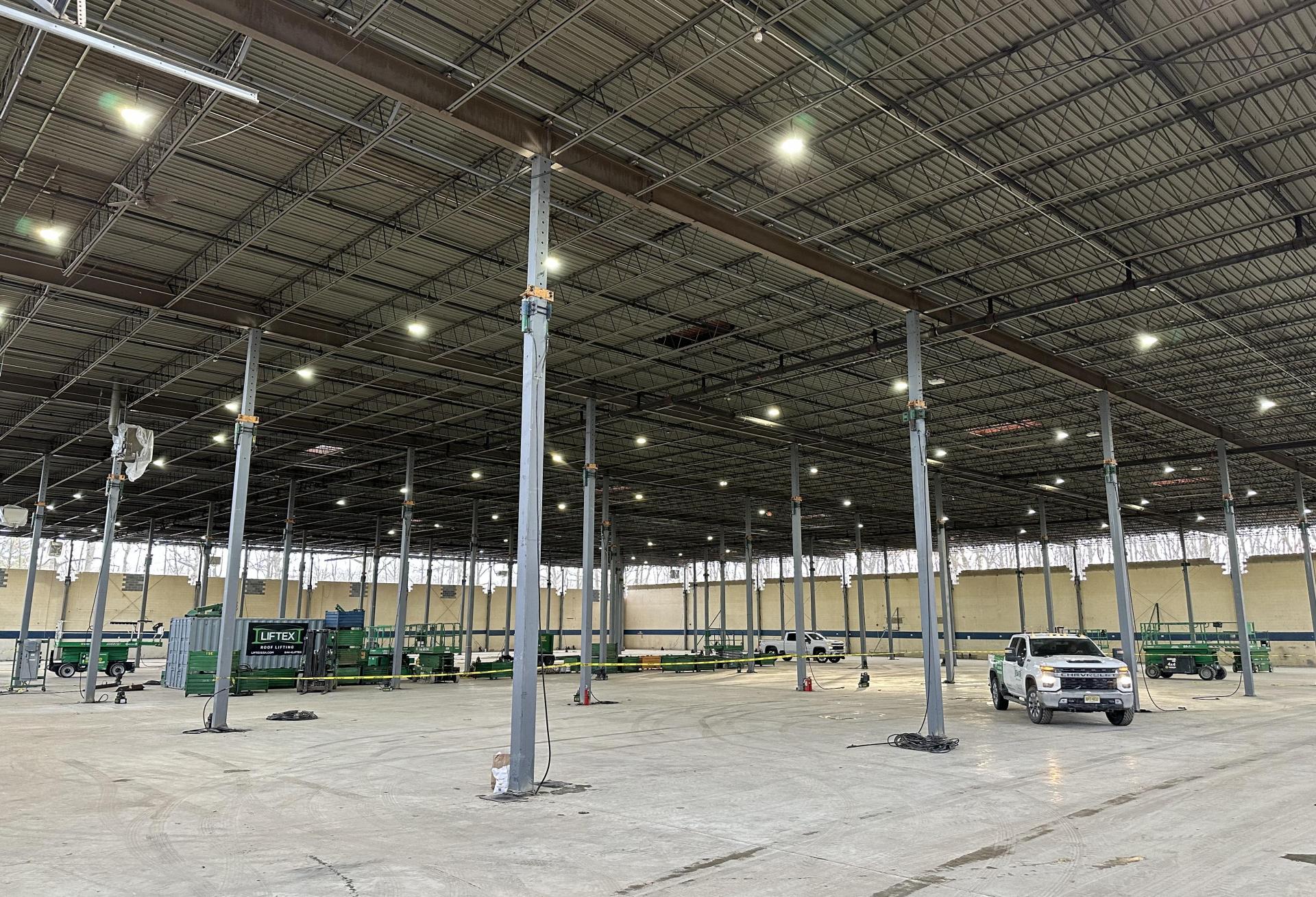
Last month, he stood inside a Greek Real Estate property in New Jersey where the process was being carried out.
The technique entails replacing a building's original supports with segmented telescoping columns raised by powerful hydraulic jacks.
Once the ceiling gets to its final height, it is reattached via bolts or welds.
The New Jersey building at 35 Kimberly Road in East Brunswick is under agreement to sell to olive oil and Italian speciality manufacturer Colavita USA. It plans to occupy the 77,500 SF space but needed higher ceilings for large tanks, where it stores raw materials, Schlindwein said.
Liftex and Raise the Roof elevated the ceilings from 22 feet to 28 feet.
A roof-raising is a good opportunity to make other upgrades, Marek said, so Greek is also boosting the building’s power capacity from 800 amps to 2,500 amps.
Pricing for these projects is highly variable, Marek said. The final cost is dependent on the original and final ceiling heights and any other changes made to the building.
It could cost between $1.5M and $3M to raise the roof of a 50K SF building, Marek said. That range jumps to $4M to $8M for a 200K SF structure.
“It’s like going out to dinner,” Marek said of a roof-lifting project.
“That’s the main course, and that’s probably going to be the biggest line item,” he added. “When you buy a $40 steak, that could be a $70 dinner or a $300 dinner, depending on what else you’re getting.”
This service isn’t a universal salve for outdated industrial buildings.
Marek spends a lot of time calculating how much a project will cost and how that compares to what revenue the building might be able to elicit without the renovation.
Greek has worked with Raise the Roof and Liftex on three different projects over the course of Schlindwein’s 17-year tenure there, but he has explored dozens of other potential roof-raisings that ended up not making sense for a variety of reasons.
“Nobody does one of our projects without comparing it to the alternatives,” Marek said.
And low clear heights aren't the only factor working against pre-2010 warehouses.
Some of the shrinking occupancy was due to a “freight recession” as e-commerce demand contracted post-pandemic, Arias said.
Smaller companies that folded during this period were disproportionately operating out of older, smaller warehouses. And the major players who remained became more focused on optimizing their margins.
“With the real estate costs, you can find a way to pull that lever,” he said.
That led to a push for more efficient automated warehouses, which shifted demand toward buildings with higher clear heights.
Power capacity is the other main factor underpinning warehouse automation, and some pre-2009 properties are also behind the curve on that front.
The average 300K SF logistics space required only about 1,000 amps in 2005, but two decades later, some are equipped with up to 4,000 amps, Schlindwein said.
Utilities aren't always able to provide as much wattage as owners or tenants would like, as power-intensive data centers have proliferated in some industrial markets, said Avison Young Industrial Capital Markets principal Erik Foster.
“Sometimes, power requirements and the ability to fill them are out of the hands of the landlord,” he said.
While the nationwide data shows rapidly depleting occupancy, Foster and Schlindwein said not all warehouses built in the 2000s are struggling with low demand.
Dense, infill markets like the parts of New Jersey at the core of Greek’s portfolio still have tenants clamoring for slightly older industrial spaces.
“I don’t think there’s just going to be this wholesale eradication of assets of that vintage,” Foster said.
)
)
)
)
)
)
)
)
)
)
)
)