
This is the first installment of Bisnow’s two-part project marking the 20th anniversary of Hurricane Katrina, examining how New Orleans’ commercial real estate market has — and hasn’t — rebuilt over the past two decades. Read Part 2 here.
It was just after 8 p.m. local time when President George W. Bush addressed the nation from Jackson Square in New Orleans with the St. Louis Cathedral lit behind him.
“Good evening. I'm speaking to you from the city of New Orleans — nearly empty, still partly underwater and waiting for life and hope to return,” he said from the dimly lit square on Sept. 15, 2005.
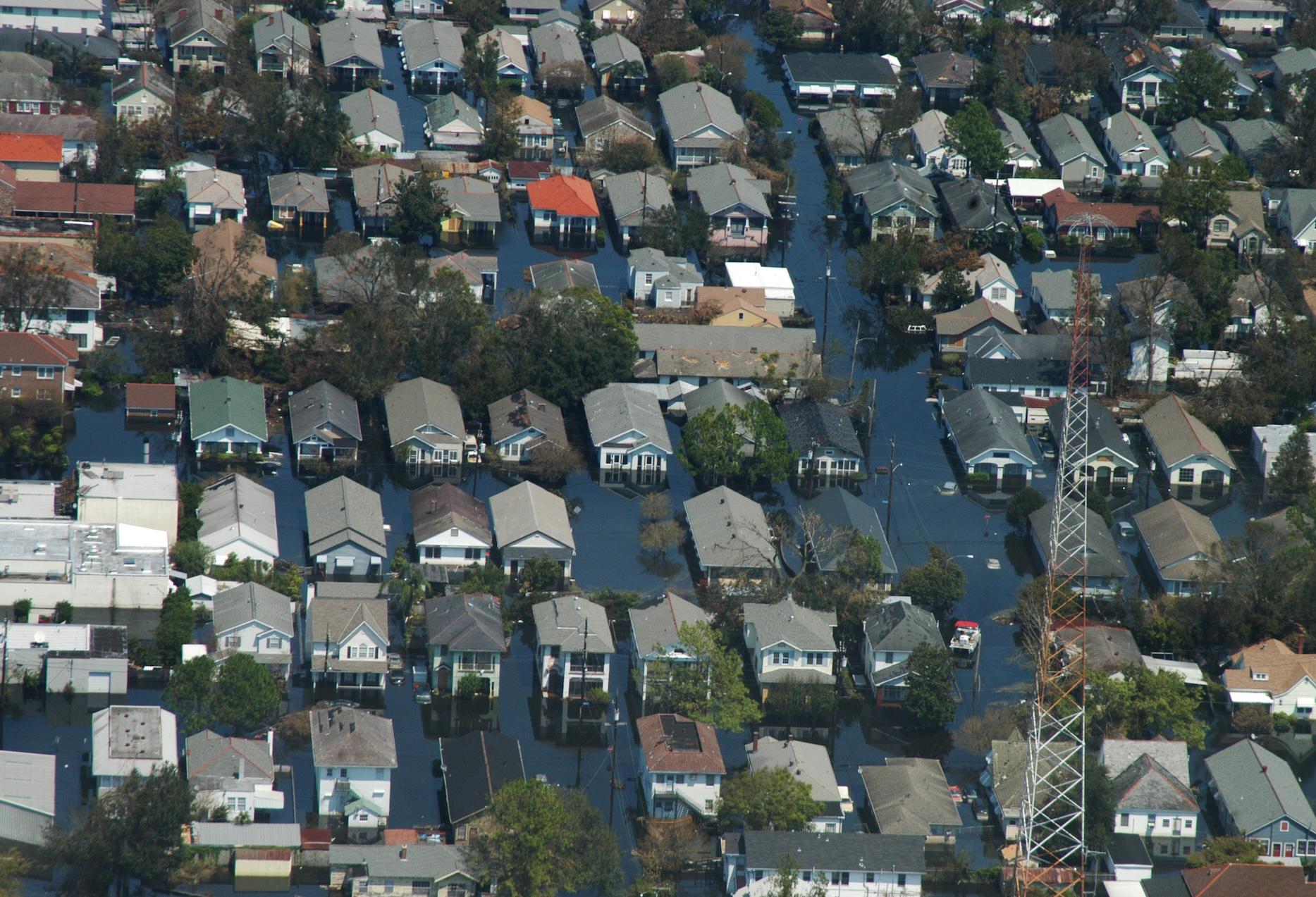
The speech came two weeks after Hurricane Katrina tore through New Orleans on Aug. 29, 2005, and as the country confronted how its government had failed to respond to the deadliest U.S. storm in modern history.
Bush promised redemption: “This great city will rise again.”

Two decades later, the promise remains unfulfilled, as New Orleans’ population and economic growth have failed to keep pace with the nation after the Category 5 hurricane inflicted $201.3B in damage across the Gulf Coast, the costliest storm in U.S. history.
A wave of real estate speculation followed closely behind.
But relief dollars dried up, and so did momentum. Less than half of the publicly traded companies headquartered in New Orleans before Katrina reopened their offices. Tourism returned — New Orleans’ allure was too strong to suppress — but the broader economic revival never did.
Ultimately, the city's sworn renaissance failed to prosper.
Two decades later, the long shadow of Katrina hangs over developers already contending with higher borrowing costs, tighter capital and rising insurance premiums — pressures that mirror the broader U.S. real estate market but weigh heavier along the Gulf Coast.
“Many of the challenges didn’t leave, and they’re still there. The storm isn’t responsible for that,” said Paul Lambert, a consultant who was contracted by the city council to draft recovery plans after the storm.
“The money that flowed into the city helped in some respects for a little while, but ultimately, you have to deal with the core problems in a different way. The storm doesn’t matter one way or the other — it still is what it is.”
Blueprints And Blowback
After Katrina, two debates — one national and one deeply local — unfolded in parallel.
On cable news, pundits and columnists sparred over the scale of government incompetence and to what degree the storm’s devastation reflected America’s deep racial inequities. However, inside New Orleans, the more urgent question was what kind of city would rise from the floodwaters.
The Urban Land Institute submitted the first major proposal less than 90 days after Katrina made landfall. It envisioned replacing New Orleans’ patchwork of dense neighborhoods and narrow streets with broad boulevards and green spaces designed to absorb future floods.
Most locals recoiled at the idea of redefining New Orleans’ urban landscape.
“It was very tone-deaf, this whole notion of essentially bulldozing neighborhoods and recapturing them without any plan whatsoever,” Lambert said.
The backlash killed the ULI’s plan, but it set the tone for years of mistrust between locals and outside planners.
Mayor Ray Nagin offered his own sweeping blueprint, the Bring New Orleans Back plan. It called on the hardest-hit neighborhoods, which were also some of the city's poorest, to prove they could rebuild or face government buyouts — at an estimated cost of $13B. Widely condemned as unfair, it too collapsed.
By 2007, the New Orleans City Council had instead adopted the Unified New Orleans Plan, a more neighborhood-by-neighborhood recovery path.
The stakes were enormous. Katrina wiped out 123,000 homes and 82,000 rental units in the metro area. All of the city’s public housing complexes were slated for demolition and replacement.
“Just imagine a million people got an eviction notice, all on the same day,” said Arthur Sterbcow, the then-chairman of the Louisiana Real Estate Commission. “Where are they going to go? When you press on a balloon, it bulges someplace else. The growth around us was explosive after Hurricane Katrina.”
Sterbcow was also leading Latter & Blum, long one of the Gulf Coast's largest brokerage firms, which lost 26 of its 28 regional offices during Katrina.
“I thought no one would be coming back,” he said.
Instead, the phones at the two surviving offices rang off the hook as buyers flooded the market even before the waters receded, paying premiums for homes on higher ground.
There were 20 buyers for every one seller, Sterbcow told the Los Angeles Times in 2005.
Lebanese-French businessman Elie Khouri pitched a 25-story condo tower on the site of a historic Woolworth’s, which had been at the nexus of protests during the Civil Rights Movement. Local developer Trey Cefalu unveiled Vantage Tower, a $60M condo project with units priced up to $480K.
And Donald Trump, then best known for The Apprentice, recommitted to building a 70-story tower with Poydras Properties that would be the tallest building in the city.
Federal policy backed the momentum. Four months after the storm, Congress passed the Gulf Opportunity Zone Act, authorizing $8B in tax-exempt bonds to spur redevelopment. In 2006, the Road Home program launched, pledging more than $8B in compensation to homeowners across the Gulf Coast, supported by $4B in federal funds.
“The luckiest thing about Katrina was it happened to us when there was an economic boom going on in the United States,” Sterbcow said. “The economy was blowing and going, so when we needed help, there was plenty of money that could flow down here.”
Visions Shrink To Scale
The storm left the city’s largest hotel, the 1,184-room Hyatt Regency next to the Superdome, in ruins.
Its owner, Strategic Hotels & Resorts, responded with another bold redevelopment pitch: a $716M plan to transform the shuttered property and its surroundings into a 20-acre tourism district, complete with a National Jazz Center, a six-block lawn, an outdoor auditorium and new civic buildings.
“For $200M we could rebuild in the same place as before in a market that needs resuscitation because of the hurricane,” CEO Laurence Geller said in 2006. “But the circumstances created an opportunity of creating something fantastic around it.”
But the grand vision never materialized. Less than two years after Geller's plan, Strategic Hotels sold the property for $32M to Poydras Properties, the same firm that had planned to partner with Trump on a downtown tower. That project was also called off by 2009, a casualty of a joint venture unable to secure financing.
The Global Financial Crisis derailed some projects, including the Trump Tower, as the country fell into a deep recession. But New Orleans was more insulated than most cities.
That’s because federal recovery dollars continued to flow, shielding multifamily developers and buoying the hospitality sector despite mass layoffs around the country. At the recession’s lowest point, the region lost less than 2% of jobs, while there was a roughly 5% decline nationally. Louisiana’s GDP grew 3.9% between 2008 and 2011, outpacing every other Southern state.
“Affordable housing developers had an opportunity to secure more subsidy than they had seen before,” said Curtis Doucette Jr., CEO of Iris Development. “The housing crisis happened in 2008, and New Orleans was not as affected as other places in the country because of the amount of money that came into the city to restore from Hurricane Katrina damage.”
The Hyatt near the Superdome finally reopened in 2011 after a $275M renovation, stripped of its tourism district ambitions. By then, dreams of a gleaming new city had faded and business leaders and developers leaned into the historic culture and architecture that had proven to be New Orleans' enduring advantage.
Instead of a National Jazz Center, a string of boutique hotel openings filled the gaps. Kupperman Cos. converted a 19th-century orphanage into a 75-room hotel in the Lower Garden District. A crumbling Marigny church reopened in 2019 as the $22M Hotel Peter & Paul before earning a Michelin Key. In 2020, a restored Uptown mansion became The Chloe, a 14-room boutique property.
“The tourism industry in particular drove a lot of commercial real estate activity,” Kupperman Cos. CEO Zach Kupperman said. “There was a ton of hotels being built.”
The Boom That Never Came
Katrina wiped out more than 110,000 jobs overnight, and they were slow to return. Two years later, the region had created fewer than 15,000 new jobs.
The federal government poured money into the city’s core industries — in 2007 alone, the Department of Health awarded more than $150M in grants to reopen hospitals and clinics — and for a time, optimism returned.
“There was a lot of recovery jobs that were created post-Katrina that lasted several years,” HRI Properties CEO Tom Leonhard said. “When that recovery money really was spent, and it took several years to do that, we probably saw a leveling off of job growth.”
The city's deeper, longstanding problems also quickly reasserted themselves, as recovery efforts were hampered by bureaucracy and weak local infrastructure. A year after the storm, more than 100,000 families were still living in trailers provided by the Federal Emergency Management Agency, and more than 325,000 remained displaced. Just 18% of public schools had reopened, and 40% of homes were without power.
“In large part, the residents of the Big Easy were victims of the predatory behavior of their own politicians,” The Wall Street Journal editorial board wrote in 2006, citing poor schools, high crime and deep poverty.
Marquee projects failed to deliver. Lift Productions broke ground on a $150M Film Factory studio in 2006, only to be derailed the next year by an FBI fraud probe that led the project to be abandoned.
Of the 23 publicly traded companies headquartered in New Orleans before Katrina, 12 had relocated within two years. Those that returned found themselves providing basic services the city couldn't deliver. Shell spent $32M buying homes for employees after monitoring school reopenings. Chevron leased an ambulance and hired a paramedic to cover emergency care.
NASA’s Michoud Assembly Facility, once a major regional employer, won a $156M contract in 2007 to support the Constellation spaceflight program. But when the Obama administration canceled the program in 2010, hundreds of jobs vanished, leaving Michoud a shell of its former self.
State and local leaders tried to lure new industries. They streamlined permitting, created tax incentives for digital media and biosciences, and launched the New Orleans Business Alliance with $1.5M in seed funding.
In 2012, seven years after Katrina, General Electric announced a 60K SF tech hub downtown, promising 300 jobs. But the corporate giant failed to deliver. By 2015, GE was winding down the business line that the New Orleans office was supposed to support. It closed in 2020, with its headcount peaking in the double digits.
Efforts to nurture a nascent startup scene gained attention but struggled to reach scale.
The Idea Village partnered with developer Brian Gibbs to redevelop 643 Magazine St. as the IP Building, an 85K SF hub for entrepreneurs.
“Once the proverbial dust settled and the city was starting to come back, the idea of startups not just being this fringe project but absolutely critical to the growth in the economy of New Orleans was more or less accepted,” The Idea Village Programs Director Andrew Albert said.
Yet Tulane University’s annual startup report shows most firms still generate less than $50K in revenue.
Through it all, tourism remained the only reliable growth engine. A record 10 million visitors had come through the year before Katrina. The number plunged to 3.7 million in 2006, rebounded to 7 million by 2007, and topped 10 million again by 2016. In 2024, the city hosted 19 million visitors who spent $10.4B — a post-Katrina record.
“New Orleans’ oxygen comes from two places. It comes from the Mississippi River, the port. That's not going away unless the Mississippi River decides to take a hard left turn,” said Sterbcow, the consultant who helped develop recovery plans in Katrina's aftermath.
“The French Quarter hospitality industry — that is our mothership. We live and die by the hospitality industry.”
Stuck In Neutral
The New Orleans metro has 350,000 fewer residents and 8% less jobs today than it did the day Katrina hit.
Despite tens of billions in federal investment, the regional economy hasn’t surpassed pre-Katrina levels since 2010. The city’s $80B in economic output in 2023 lags New Orleans’ 2004 performance. Poverty stands at 23%, down from 25 years ago but still nearly double the national average. Louisiana’s public schools are ranked higher than ever, but their position in 37th place offers little comfort.
“The economic transformation remains a work in progress,” researchers at the Brookings Institution and The Data Center wrote this month. “Entrepreneurship is a bright spot, and if well-fortified and directed, can help the economy to diversify and weather the shocks ahead.”
The physical scars of Katrina linger, too. Faded paint lines marking the high water stretch across French Quarter buildings — reminders turned into tourist attractions.
The $14B system built by the Army Corps of Engineers held when Hurricane Ida struck on Aug. 29, 2021, exactly 16 years after Katrina. Ida killed 91 people and caused $84.6B in damage, the sixth-costliest storm in U.S. history, but floodwaters stayed out of New Orleans’ core.
The storm and the type of destruction in its wake offered a picture of both progress and limits.
“It was naive to think that we can put everything back the exact way it was and everything’s going to be fine again. It just wasn’t realistic,” Sterbcow said. “No businesses wanted to relocate their tech center to where it could flood again.”
Since Katrina, more than a dozen major weather disasters have hit the region. The National Oceanic and Atmospheric Administration now forecasts that New Orleans will flood to some extent every year, no matter the levees. The Urban Institute estimates the Gulf Coast will lose $71B annually by 2050 to climate hazards.
The Woodwell Climate Research Center projects that what were once 100-year floods will strike every few decades by midcentury. Globally, climate change has already driven $4.3T in losses over the last 50 years, according to the World Meteorological Organization, while GIC, Singapore’s sovereign wealth fund, warns of $559B in potential real estate asset losses over the next 15 years.
For New Orleans, the most immediate effect is insurance. Premiums have surged since Ida, and a 2024 Deloitte report projects costs will double again by 2030 in high-risk states like Louisiana. Some developers now struggle to secure coverage at any price, while other corporate occupiers are retreating to the suburbs to escape costs.
“Insurance is a big issue, and that’s probably the only set of handcuffs we’ve got,” Sterbcow said. “Insurance is driving where our businesses go and where our homeowners are allowed to stay.”
)
)
)
)
)
)
)
)
)
)
)
)