
The Chicago Bears’ stadium saga has spanned seven starting quarterbacks, three head coaches and two playoff games, leaving fans, lawmakers and developers tapping their watches as the team drags out its search process for a new home.
People have been asking a lot of questions about the process, and Bisnow has your answers.
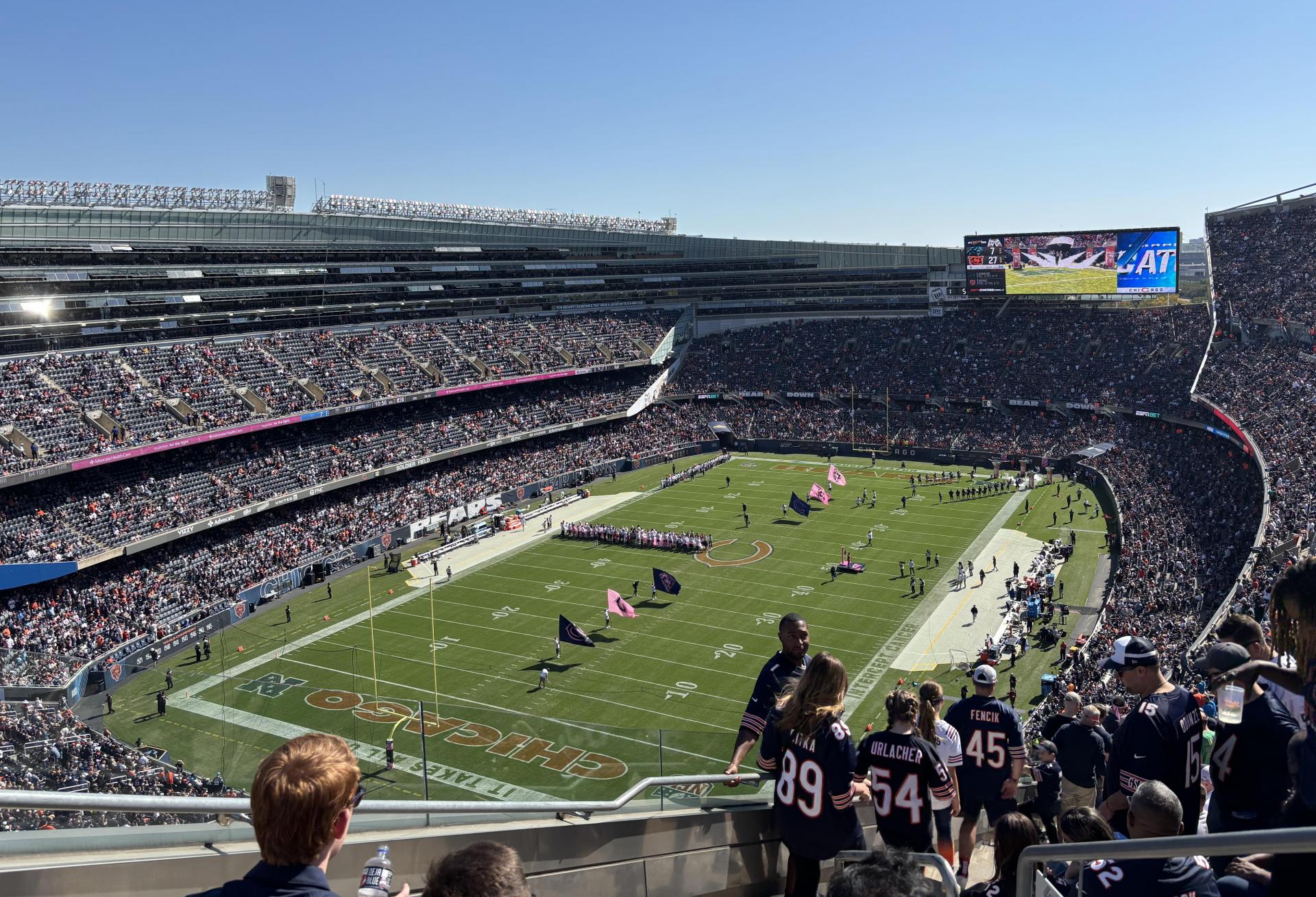
Table of Contents
- Why are the Bears leaving Soldier Field?
- What incentives is Indiana offering to build in Hammond?
- What is Illinois offering to keep the Bears in the state?
- What has to happen next for any stadium plan to move forward?
- How much would a new Bears stadium cost?
- When could a new Bears stadium realistically open?
- What are alternate uses for the Arlington Heights site if the team moves to Indiana?
- What would a move mean for development in Indiana?
- What would a Bears move mean for the Chicago Lakefront and Soldier Field?
- What are CRE stakeholders saying about the potential move?
Why are the Bears leaving Soldier Field?
Soldier Field is the smallest stadium in the National Football League, and the oldest in the league by a large margin. The team, which has called the stadium home since 1971 but does not own it, wants a domed stadium so concerts, major championships and other events can take place year-round.
The team kicked off the process to find a new home when it signed a purchase agreement for the former Arlington Heights Racetrack in 2021 and closed on it in 2023.
What incentives is Indiana offering to build in Hammond?
Indiana Gov. Mike Braun signed a bill at the end of February that establishes a financial framework for a new Bears stadium in Hammond. The team would put up over $2B for the project, while Indiana would invest around $1B through various financing mechanisms.
Those mechanisms include a food and beverage tax, an innkeepers tax and an admissions tax to repay the bond the state would issue for the construction of a new stadium. All the taxes are set to expire when the stadium is paid off.
After Indiana legislators passed the bill, the Bears organization stated that it appreciated the “important steps” the state had taken over the last few months and that it would continue to conduct necessary due diligence. Environmental studies on the Hammond site remain outstanding.
What is Illinois offering to keep the Bears in the state?
The suburban Arlington Heights site is still a prime contender to house the team. On the same day that Indiana passed its stadium bill, an Illinois House committee passed legislation to allow the Bears to negotiate reduced payments in lieu of property taxes. The team would need to make an annual payment to the suburb equal to at least 10% of the property tax levied in the previous year and would have to operate in the area for at least two decades.
The move is one of the first signs that Illinois may be willing to open the public coffers for the stadium after Gov. J.B. Pritzker’s lukewarm reception to the idea in 2024. The full House reconvenes on March 18, and it’s unclear whether the measure will pass the larger body. Yet to be determined is the hundreds of millions in infrastructure funding the team is asking the state to provide.
No matter how the interstate scuffle resolves, the team is unlikely to build the lakefront stadium in Chicago, as it proposed in 2024, Pritzker said in late February.
We want to hear what you think about a possible Chicago Bears move:
What has to happen next for any stadium plan to move forward?
The Bears will continue evaluating the viability of the Indiana site while waiting to see if Illinois legislators move forward with their property tax bill when the legislative session resumes this week. The key to unlocking the next steps will be a financing deal that the team approves of at a site it prefers.
How much would a new Bears stadium cost?
Cost estimates have evolved over time. The Indiana proposal would have the Bears pay $2B for the stadium, while the state contributes up to $1B. In Arlington Heights, the team wants to build a $5B mixed-use development and is seeking an estimated $855M in infrastructure funding from the state.
When could a new Bears stadium realistically open?
The timeline for the team to build a new stadium is roughly three years from the start of construction, team President Kevin Warren said when the Bears organization unveiled its lakefront proposal. Each year the project is delayed would add $150M to $200M in costs, he said at the time.
What are alternate uses for the Arlington Heights site if the team moves to Indiana?
Even if the Bears don’t set up shop in the Chicago suburbs, the location still has the potential to become a mixed-use development, said Hugh Williams, co-founder of KWILL Merchant Advisors. The village could leverage its highway and rail infrastructure to become a “dominant west and northwest anchor,” he said.
It’s not a foregone conclusion that the team would have to sell the site, which it paid $197M for in 2023. The Bears could partner with a major developer that works with them in both Indiana and Arlington Heights to build a pair of mixed-use developments in tandem, Williams said.
What would a move mean for development in Indiana?
Leasing conversations near the Indiana site are already underway, even though the decision is not finalized. Jeff Bennett, managing director at Bourbonnais-based McColly Bennett Real Estate, said the Bears stadium discourse enabled him to get in the door with the potential client he is touring in Whiting, Indiana.
“The Bears become five minutes of the conversation that allows you to move on to the next step,” Bennett said. “It's still good real estate. It's still in a good area, but you can get in the door with the Chicago Bears.”
Investment in the area won’t hinge on the Bears coming to Indiana because no one knows how long that decision will take, Bennett said. But the discussions themselves make it easier to point out that stretch of Indiana on the map.
Williams said that while not in Illinois, the Indiana stadium would be close enough to help bolster the South Side of Chicago as an anchor.
“If we could get that stadium built in Indiana, I think that helps all the south,” Williams said. “It helps the south suburbs. It helps east along 80, it helps South Chicago. It helps Gary, Indiana. It really helps create a strong center of industry there. ”
What would a Bears move mean for the Chicago Lakefront and Soldier Field?
The Chicago Park District, which owns Soldier Field, has proposed capital improvements to state lawmakers to keep the stadium running as a year-round events venue if the team bolts for greener pastures. The improvement plan, which would see public transit upgrades and renovations to practice areas, comes with a $630M price tag.
The stadium is the largest source of non-tax revenue for the Park District and pays for the yearly equivalent of all of the city’s lifeguards, camp counselors, park attendants, laborers and maintenance staff. Bears games currently make up less than 20% of the stadium’s revenue, and concerts and other events are prohibited within five days of a team home game.
Developer Bob Dunn has also announced plans to get his stalled One Central megaproject, a development just west of Soldier Field, off the ground. The exact shape of the scaled-down project is unclear, but it has some state support.
What are CRE stakeholders saying about the potential move?
Bennett has had Chicago Bears season tickets in Section 226 of Soldier Field’s south end zone for decades.
He also has a prospective client touring a site in Whiting, Indiana — a stone’s throw from the Bears’ proposed Hammond stadium site. Bennett’s heart and business interests are pulling him in different directions.
“As a fan, I would prefer to go to the lakefront,” he said. “I'm slow to change. So I love where it's at.”
Still, there is widespread precedent for a move outside of city limits. Ten NFL franchises do not currently play in the cities their teams are named after, including both New York teams and the Dallas Cowboys.
Williams said many people are invested in this purely on an emotional basis.
“This is a big, big thing, but it's really just a big, big thing because it's emotional,” he said.
)
)
)
)
)
)
)
)
)
)
)
)