
Sustainability initiatives are changing the way business is executed in every corner of the economy. However, while the healthcare industry has always prioritized innovation in clinical care, the sector has been slow to adopt many sustainable environmental practices.
In 2021, only 4% of healthcare institutions surveyed by the Future Health Index stated that including environmentally conscious practices into their operations is a priority. Considering the industry's carbon emissions make up nearly 5% of the world’s net emissions, there are greater calls for healthcare facilities to reduce their environmental footprint.
The industry finally seems to be taking notice. The 2022 edition of the FHI report found that nearly 25% of healthcare providers are prioritizing environmental sustainability, signaling the willingness of the industry to adapt to climate needs.
“Historically, I think most healthcare professionals have always looked at the metrics around energy consumption as an operating cost,” said Jeffrey Rios, partner at AKF Group. “As carbon emissions become more important in the industry conversations we're having, we’re revisiting what sustainability means for healthcare institutions.”
AKF Group is an engineering, design and technology firm that dedicates its practice to optimizing the built environment. To reduce environmental impact, the firm also implements eco-friendly solutions for new and existing real estate assets.
Rios said that healthcare institutions across the country, particularly in the Northeast, burn fossil fuels on-site for large steam boilers, serving space and water heating, and sterilization systems. This process emits carbon dioxide into the atmosphere, which contributes to climate change.
In response, medical facilities like Maine Medical Center are now thinking of how they can further reduce their carbon footprint.
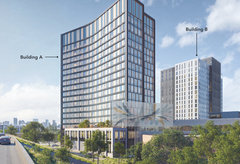
With the help of AKF Group, the Malone Family Tower at the Maine Medical Center, a new 265K SF cardiovascular facility, is adopting energy-conscious lighting options and an air delivery system that will allow for greater efficiency in intensive care units and off-hours change reductions.
This $500M addition to the state’s flagship medical facility is set to open in 2024 with a total of seven floors, a sterile processing department, 96 beds in private patient rooms and new surgical spaces.
“Maine Medical Center has already made strides toward achieving a sustainable future,” said Lance Brown, senior engineer at AKF Group and MMC project manager. “When planning this project, we wanted to ensure there could be room for further expansion. That’s why after the first four floors were designed, MMC added the fit-out of floors five and six to keep up with impending demand from the greater Portland community.”
Rios said traditional energy reduction projects like low-energy lighting and improved air systems are viewed as sustainability solutions for today. Long-term goals are based around sourcing carbon-free energy solutions to power the systems needed for medical facilities.
With long-term energy solutions in mind, AKF has set its sights on helping MMC transition the sterilization process from a steam-based energy system to an electric-based energy source, he said. Since the sterilization process is incredibly important to the well-being of a medical facility’s patients and staff, sourcing a new energy alternative will not only allow MMC to take a big step toward reducing its carbon emissions, but will help provide its patients with the modern care they need.
“There are many moving parts in a building this size, and Maine Health has been very forward-thinking in planning for the future," said Caitlyn Angelini, partner at AKF Group. “The size of the building creates more opportunity for change and innovation.”
Other health facilities that are looking to improve their energy-efficiency should have a long-term plan, Rios said. It may take up to 20 or more years to decarbonize healthcare facilities and become free of fossil fuels, but by putting in the work now, these facilities may see sustained benefits for years to come.
This article was produced in collaboration between the AKF Group and Studio B. Bisnow news staff was not involved in the production of this content.
Studio B is Bisnow’s in-house content and design studio. To learn more about how Studio B can help your team, reach out to studio@bisnow.com.