The final panel of Bisnow’s National Healthcare Expansion & Innovation Series took a hard look at the future of healthcare, and what providers will have to do to adjust to decreasing margins and capital.

Although the results of the election have called the future of healthcare in America into question, providers will be facing the same issues they discussed on Tuesday—namely, constant downward pressure on reimbursements, and the resulting decrease in available capital.
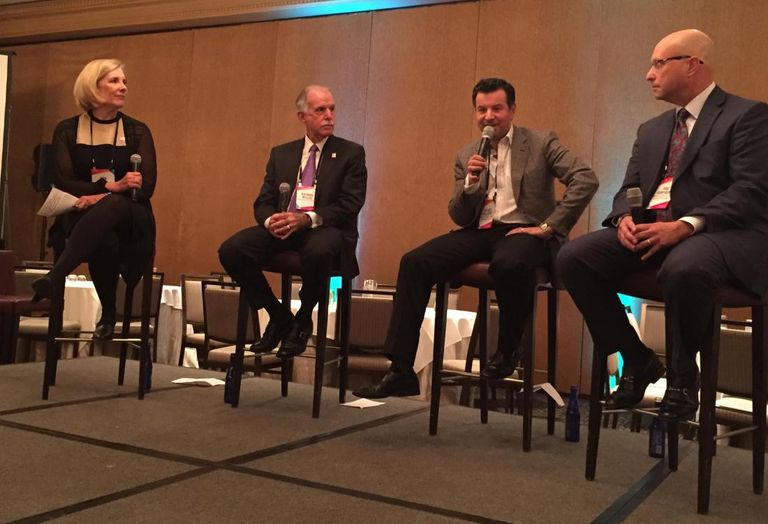
“There’s no question the revenue stream from the hospital will be less,” says Virtua Health president Richard Miller (above). “The survival of hospitals in the future will depend on how they can expand their outpatient business.”
Healthcare and hospitals are still a basic necessity, but they can’t depend on their essential nature for their continued existence—they need to change with the times, and that costs money.
“The problem in the long run is that, as technology evolves very rapidly, its cost isn’t cheap,” said Paul Kempinski (below, far right) of Nemours/Alfred I. duPont Hospital for Children. “So we’re going to have to accommodate the new technology, but the access to capital and the operational implications of that are going to be two major opposing forces.”
There are ways for providers to adjust to such forces, and they were discussed at length. Mergers and acquisitions came to mind immediately, as they’ve been commonplace in the healthcare market over the past few years.
“There’s less capital available for hospitals,” Richard said. “So when you look at M&A activity in the marketplace, hospitals are looking for partners with capital.”
Partnering for the purpose of capital is one avenue, but another is partnering with other networks that have complementary systems; in the future, not every provider may be able to provide every service.
“Do we invest in everything?” Richard asked. “Or are we going to need to specialize? Are there some products and services from a hospital perspective we can’t be in anymore?”
Still another way healthcare systems can increase in size mitigates the blows of decreasing per-patient revenue is across regions: “more super-regionalization of care,” Paul said.
Jersey City Medical Center COO Michael Prilutsky (above, second from right) says super-regionalization is the “next step.”
“That’s going to lead to a lot of building and activity,” Michael said.
Of course, nothing is as expensive in healthcare as intensive treatment or major surgery, so perhaps the most positive step a system can take is to be more proactive in the health of its patients, something emerging technology will be crucial in facilitating.
“System access will increasingly be from [the patient’s] home,” Paul said, “from a wearable device that will begin to transmit information not just to their physician, but right into their medical record, which will prompt more real-time care in the moment.”
While that sort of technology isn’t present in the market quite yet, it is representative of the urgency providers feel in streamlining their care, both to increase their own efficiency and to improve the customer experience. It’s important to be able to meet as many of a patient’s needs as possible as quickly as possible.
“The full-service mindset of building is important,” Richard said, “because people will pay a little extra—not a lot, but a little—for full, A-to-B service.”
In an industry where the margins look to continue to squeeze into the future, a little goes a long way.