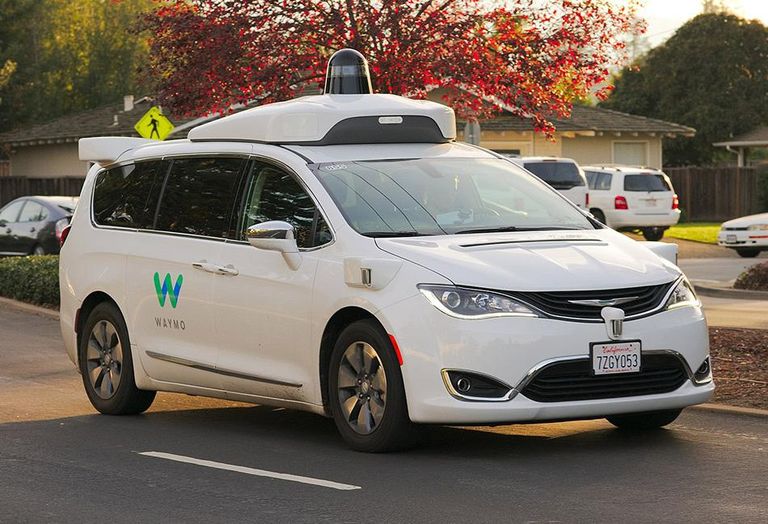
The valuation grabbed headlines: Analysts at Morgan Stanley had increased their estimate of what Google’s Waymo autonomous vehicle division could be worth from $75B to $175B.
But for the real estate industry Morgan Stanley’s valuation is not important. What is noteworthy is that the investment bank thinks the technology will have a huge impact on retail, last-mile delivery and property owners.
First retail, where Morgan Stanley thinks Waymo can have a positive impact on quite literally driving people toward brick-and-mortar stores.
In July Waymo announced a partnership with Walmart. People in Waymo’s early rider trial programme in Phoenix got a discount when they ordered groceries on Walmart’s website, and riders are also able to take a Waymo car to pick up their order. There was also a partnership between a Phoenix shopping center and Waymo.
“This is another way to serve existing customers and a possible way to attract new customers,” Morgan Stanley said. “In addition to increasing the convenience of shopping via click-and-collect for existing customers, we believe the novelty of riding in a self-driving car could entice new customers to shift grocery spending to Walmart.”
It said the true test of whether these partnerships would be beneficial is if they stayed profitable once the novelty of self-driving cars had worn off.
Morgan Stanley also positions the partnership between Google/Waymo and Walmart as part of the fight against Amazon.
“We could see a hypothetical scenario in which a consumer one day searches for a product on Google, finds it at a retailer which offers a discount, and clicks a “take me to the store with Waymo” button to complete the purchase,” it said. “This reduces, but does not eliminate, the relative attraction of having items delivered directly to your doorstep.”
Early results of how the roughly 20,000 people who have signed up for the early rider programme actually use Waymo indicate that it will be beneficial for retail.
According to Google, seven of the 10 most popular trips taken by early riders relate to retail or leisure activities: going to restaurants, bars, retail stores, salons or spas, supermarkets, electronics stores and gyms, in that order.
“Self-driving cars would ease the friction associated with shopping in-store for example by eliminating the need to find parking, which may drive greater traffic in store.”
Morgan Stanley identifies another positive impact on retail, which may be negative for another real estate sector: last-mile logistics. The company said that as well as personal journeys, Waymo has an obvious use in both long-haul and short-haul logistics. It could allow retailers to better compete with online giants like Amazon.
“Autonomous vehicles should eventually enable faster and cheaper last-mile delivery, improving the customer experience by potentially enabling less than one-hour delivery from local stores to the customers' homes rather than from a centralized warehouse to the customer, while narrowing the margin gap between store and e-commerce sales,” Morgan Stanley said.
“Waymo could help traditional retailers better compete from a cost and service perspective against Amazon. In effect, Waymo could enable retailers to build their own Prime Now equivalent. Therefore, we believe retailers will use autonomous vehicles for delivery as the cost falls below current cost of delivery, which is roughly $4-5, or 4-10% of gross margin based on our industry conversations.”
Morgan Stanley outlines how this could allow Waymo to disintermediate traditional parcel firms like UPS. But it would also reduce the need for last-mile logistics facilities, currently one of the most popular sectors for real estate investment.
Finally, Morgan Stanley outlined a benefit from Waymo for REITs generally, and indeed real estate owners of all stripes. The company, and autonomous vehicles in general, could eliminate the need to include car parking in buildings.
“Waymo and competing ride-hailing services could reduce parking spaces thereby allowing for increased densification, to be used for alternative uses like office, storage, and multi-family, a net positive for REITs over time,” it said.
For a deeper discussion of how autonomous vehicles and other elements of the shared economy will impact real estate, come to Bisnow's London Sharing Economy Phenomenon event on 30 October at 7.30am.