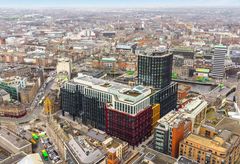
The artificial intelligence boom has supported the U.S. economy, global stock markets — and the London office market.
AI firms are among the most active tenants and are paying among the top rents in London, the audience at Bisnow’s London Office Leasing Trends and Occupier Demands event heard.
And while that is not necessarily a bad thing, it does create unintended consequences for the broader market.
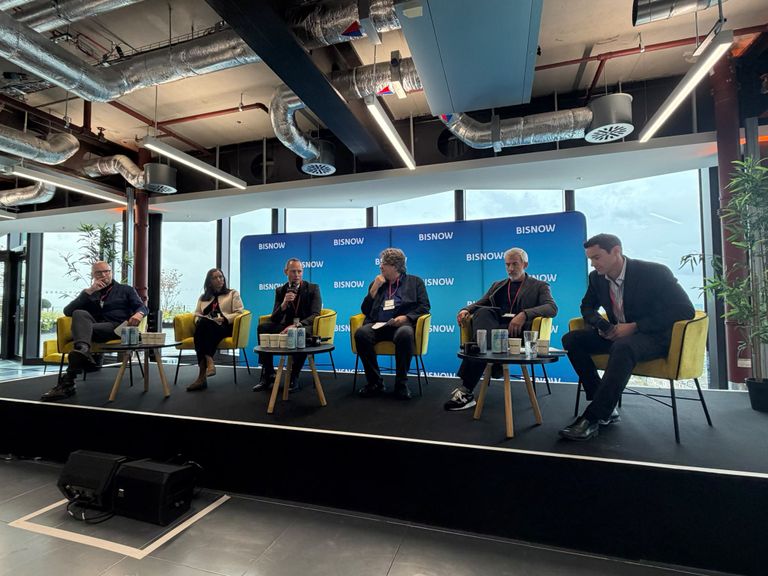
“AI companies are largely paying these very high rents. That's then setting the bar for the rest of the market and distorting the market in many ways,” Workspace CEO Charlie Green told the event, held at the 10 Emberton Walk office building, part of the new Olympia development.
Maybe that trend will last, and income from AI firms will prove resilient, Green said. Maybe it won’t.
“But it's just interesting how it impacts all of us,” Green said.
The knock-on effect is that every office owner sees rents growing in AI-heavy buildings and areas — they are up 6% in the West End and King’s Cross so far this year and 9% in the City, according to BNP Paribas Real Estate — and thinks, “I want a piece of that,” Green said.
So even if owners haven’t invested to improve buildings, they’re raising prices, Green said. That can put companies off moving, but it also presents an opportunity for owners to offer more affordable rents on good-quality older buildings.
Green said there has been a shift in the London office market. In the wake of the pandemic, amenities were king, and companies desperate to get staff back to the office were willing to pay top dollar for the best-quality space.
Today is different. Office space is still only a small proportion of a company’s costs, but inflation is pushing up costs, especially wages, across the board. That puts rent affordability back in the spotlight.
“I think that companies are going to be thinking harder about how much they're paying and what are they getting for what they're paying,” Green said.
“Perhaps we're moving away from that flight to quality that everybody talked about post-pandemic, and perhaps now we're moving into a flight to value.”
Amenities and prime space are also prioritised less in a weaker job market, as employers have more leverage to order employees back to the office.
“Whereas before, amenity was No. 1, and CEOs and C-suites willing to pay for it, I think that's now coming lower in the agenda because that power has probably now shifted from employees to employers,” Nuveen Director Ilna Patel said.
The eternal truism of property is coming back to the fore — location is a key driver for occupiers. If a business is in a vibrant area, full of gyms and cafes, they don’t necessarily have to pay to have that in the office.
More prosaic elements like good-quality WiFi are now coming above amenities that might be nice to have but are not deemed essential.
"If you don't hit their resilience, they're not coming to you,” Patel said. “It doesn't matter how great the building is, where it is, they just won't come to you.”