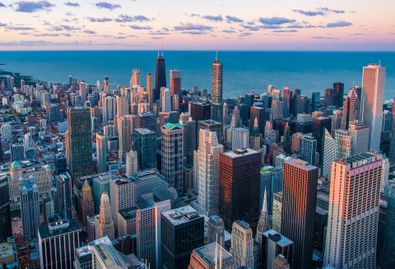
They only rise 65 stories but their distinctive design defines downtown as much as Willis Tower, the John Hancock Center and the other supertalls kissing the sky.
:no_upscale():quality(75))
Fetch your copy of Wilco's Yankee Hotel Foxtrot and settle down. Today, the Forgotten History of Chicago Supertalls takes a look at the twin corncobs of Marina City.
1. It Was Conceived As Workforce Housing
:no_upscale():quality(75))
Chicago in the 1950s and 1960s was the center of several ambitious urban renewal projects, but Marina City was in a class by itself. It was conceived by William McFetridge, head of the Building Service Employees International Union, as affordable housing for the union's singles and childless married couples who preferred easy access to work and entertainment over homes in the suburbs. (Sound familiar?) Marina City was one of the most ambitious mixed-use developments of its time,and the first downtown high-rise project to incorporate the Chicago River as an amenity.
In short, Marina City is a trailblazer, readers.
2. The Site Posed Challenges
:no_upscale():quality(75))
McFetridge, real estate developer Chuck Swibel and architect Bertrand Goldberg scouted eight other sites before Goldberg showed them 3.1 acres along the river owned by the Chicago Northwestern Railroad. But there were some obstacles to securing the site. First, Swibel convinced the railroad to sell the site for well below its $3.9M asking price; it sold for $2.5M.
Second, Goldberg had to design a commercial infrastructure for everyday life from scratch, which didn't exist in the downtown of 1950s Chicago; River North was mainly a warehouse district at that time. Goldberg made plans for a movie theater (which today is home to the House of Blues) and a restaurant on the site, while the river would house a marina for boaters.
The biggest challenge Goldberg faced was drafting a plan that would pass the conservative single-use zoning restrictions of the day. Mixed-use downtown development was discouraged. Thankfully, the project had another champion in Mayor Richard Daley, the most powerful big city leader of his time. With the "Boss" behind the project and the site secured, Marina City was fast-tracked.
3. It Introduced The Climbing Tower Crane To American Construction
:no_upscale():quality(75))
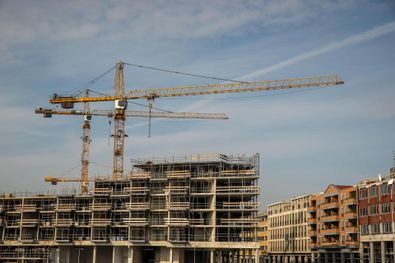
When Hans Liebherr invented the tower crane in 1949, it revolutionized construction. Prior to its advent, cranes could lift vertically but had no horizontal movement, and materials had to be hauled by hand once a crane dropped them off. The Linden climbing tower crane, developed in Denmark in 1959, had the added advantage of being able to be broken down, transported, and assembled at the construction site, and could rise as a building was built upwards.
Marina City's small site and the height of its twin towers called for innovation. It was the first official use of the Linden climbing tower crane in American construction. This facilitated speed to market for the project and made for a truly futuristic sight in 1960s Chicago.
4. They're True Identical Twin Towers
:no_upscale():quality(75))
Goldberg designed each tower to be exactly the same. They contain 450 apartments and 896 parking spaces each, and share a below-grade mezzanine level. The top floors are 360-degree rooftop decks, which provided then-unobstructed views of downtown.
Perhaps the most intriguing of Goldberg's design quirks is the near-lack of right angles in the apartments. The apartments are wedge-shaped, with the kitchens and bathrooms near the point of the wedge, and the living areas on the outermost portions. The design was ahead of its time and eventually became Goldberg's most recognized project.