President Donald Trump said Wednesday that he will require data centers to provide their own electricity and sell excess power to nearby communities to hold down electricity prices.
The comments come as opposition to data centers — and concern over their impact on homeowners’ utility bills — has emerged as a top campaign issue that could undermine Republicans’ chances in the upcoming midterm elections.
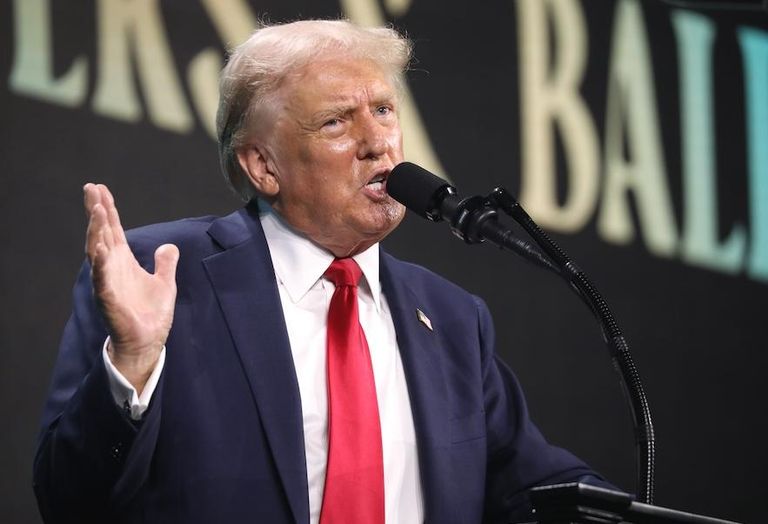
“As the President of the United States, I have been watching Data Centers very closely, and have come to a very strong conclusion,” Trump wrote in a Truth Social post. “New and large, in some cases gigantic, Data Centers are mandated by me to make their own electricity, and give or sell any excess back to the local community, or grid, and therefore there is electric price increase (sic). In fact, there could be a substantial decrease.”
In the same post, Trump also urged developers and technology firms behind data centers to offer monetary incentives to nearby residents and local governments as a way of gaining support for projects that are increasingly being delayed or derailed entirely by community pushback.
“If companies want to make their Data Centers popular, pay the community, and/or individuals within the community, a “dividend,” Trump wrote. “I have watched the process closely, and Data Centers that were highly unpopular in a certain area, have become extremely popular when a financial deal is struck. MAKE DEALS, and get them built!!! GREAT FOR THE U.S.A.”
Trump has been a strong supporter of data center development across the U.S., often framing it as an issue of national security amid an artificial intelligence arms race with China. In previous posts on Truth Social in August, the president directed sharp criticism at local pushback against data centers, saying communities that opposed these projects were handing China an AI advantage and would “end up being backwards and poor.”
The shift in tone in Wednesday’s post comes as widespread animosity toward data centers has become a potential liability for Republicans ahead of November’s midterms that could help shift the balance of power in Washington. While candidates from both parties have made data center opposition part of their platform, it has largely been a Democratic talking point, particularly as the Trump administration has cheered the industry’s growth.
There is concern among GOP officials that the issue could hurt the party's fortune in key races. In August, the National Republican Senatorial Committee sent a memo to major tech and AI firms warning that Democrats were successfully making data centers the “centerpiece” of their campaign to unseat Republican Sen. Jon Husted in Ohio. The NRSC argued that increasingly negative public sentiment toward data centers has uniquely hurt the GOP’s chances in the Senate.
“This has become a sleeper issue for the entire election cycle,” the letter warned.
It is unclear whether Trump’s “mandate” will be accompanied by any executive action, but the idea of data centers generating their own power to ease strain on regional grids isn't a new one.
Developers are increasingly pursuing projects with on-site or “behind-the-meter” power generation amid yearslong wait times for grid connections. Massive campuses like Meta’s Hyperion facility in Louisiana are being co-developed alongside power plants that are also connected to local transmission systems.
States and regional grid operators have also been pushing for requirements that data centers provide their own generation as a prerequisite for a grid connection. Notably, efforts to impose these requirements across the country’s largest grid system were rejected this month by the Federal Energy Regulatory Commission, which is led by Trump appointees.
This isn't the first time the Trump administration has turned its attention to consumer concerns over data centers driving up electricity prices. The administration’s Ratepayer Protection Pledge, announced in March, aimed to address the same concern, with major tech firms committing to cover the full cost of power delivery and grid updates needed to serve them — although what constitutes “full cost” has remained a matter of interpretation.
Trump’s suggestion that data center firms pay dividends to local communities also echoes practices that have become common across the sector. Not only do developers tout the tax benefits that data centers provide for local governments, they routinely offer additional community benefits to win support, from funding local institutions and buying trucks for fire departments to rebuilding a bowling alley.
While direct cash payments are rare, they aren't unheard of — even if they don’t always work. Just this month, residents in Hazle Township, Pennsylvania, rejected a proposed Amazon Web Services campus whose developers had promised a $10,000 cash dividend to every resident.