Good location decisions can significantly boost a company's long-term performance. Poor ones can cost millions in lost talent, productivity and capital, according to JLL head of business location consulting Matthjis Weeink. We spoke with Weeink about how companies are making decisions about where to put down roots.
:no_upscale():quality(75))
The overarching trend in London is companies seeking out cost-saving opportunities. They’re looking outside of London in the Big 6, if feasible for their business goals, giving more thought to the purpose of their office space. Workers with client-facing roles may remain in London in a branded trophy building, while operations like IT and admin support might be shuttled outside the city, Weeink said.
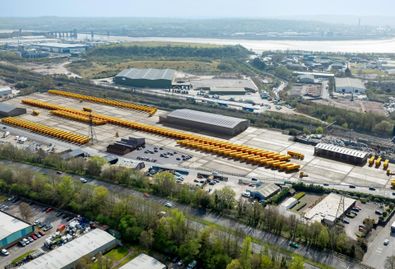
For instance, Bristol (shown below) is an up-and-coming area attracting companies. The city has a talented workforce, several universities and lots of R&D activity. The cost of housing is significantly lower than in London. Clusters of life science and biopharm companies are gathering in Oxford and Cambridge, where the brainy students and lower cost of living are spurring growth. Birmingham and Manchester are getting a second look for business services. Broadening the scope to all of Europe, Poland is the forefront of business support, Weeink said.
:no_upscale():quality(75))
Though he has not yet seen companies departing London because of Brexit, he noted that many companies, particularly financial firms, are creating contingency plans. Weeink said Theresa May indicated there would be a ‘clean Brexit’ so companies are creating different scenarios to develop a strategy that will work in a world of uncertainty.
For tech and creative companies based in London, the arrival of co-working spaces has changed the decision-making process somewhat, Weeink said, but an even more innovative real estate solution is happening in financial companies. Some big banks are offering startup space to fintech companies. For startups, the advantages are obvious, but the financial companies are benefiting too. Often they give input on the creation of some of the technology and are the beta customers.
Cities are always changing, Weeink said. New investments are always coming online and new enterprise zones are formed. Weeink pointed to the regeneration of brownfield sites, such as the Liverpool embankment, as a factor in the location decision. Developers completely rebuilt the promenade with retail and dining and now it is a place where people really want to be. Another example is the Guggenheim in Bilbo, Spain. The area was a wasteland, Weeink said, and a single well-developed, high-end art museum transformed the entire area into a thriving tourist destination.